Module 6: AI, the Production of Knowledge, and the Academic Research Market

Watch: Module 6 walkthrough (8 min, narrated slides)
For five modules you have been building. You pulled a firm-year panel from public filings in an eighty-minute lab, turned a folder of 10-Ks into a defensible text measure, connected an agent to WRDS on your own credentials, and hardened one of those pipelines into a repo a stranger could rerun from the README. In 2019, each of those tasks would have taken a competent RA days to weeks. This seminar is about that change. There is no lab in this module. You already know how to do these things. The question now is what it means for the profession that anyone can.
The seminar is organized around three questions, from least to most uncomfortable. First, if AI produces the artifact, what happens to the learning? What is PhD training for? Second, does it matter, epistemically or socially, whether a human or a machine produced a result? Third, papers are the currency of the academic labor market. What happens to that market when the cost of producing a competent paper collapses? None of these questions has a settled answer. You will be asked to defend a position, not to find the right one. The deliverable is a one-page memo titled “What I will still be paid for in 2036,” and it asks you to commit to your own answer.
The map you already know
In Module 1 you saw the research pipeline (idea, data, measure, analysis, paper), shaded by where an agent speeds up the work and where judgment stays human. You have now worked through that map across the course, so this module uses a harder version of it. The same pipeline is plotted on two axes: how automatable each stage is, and how much of the paper’s value it carries.
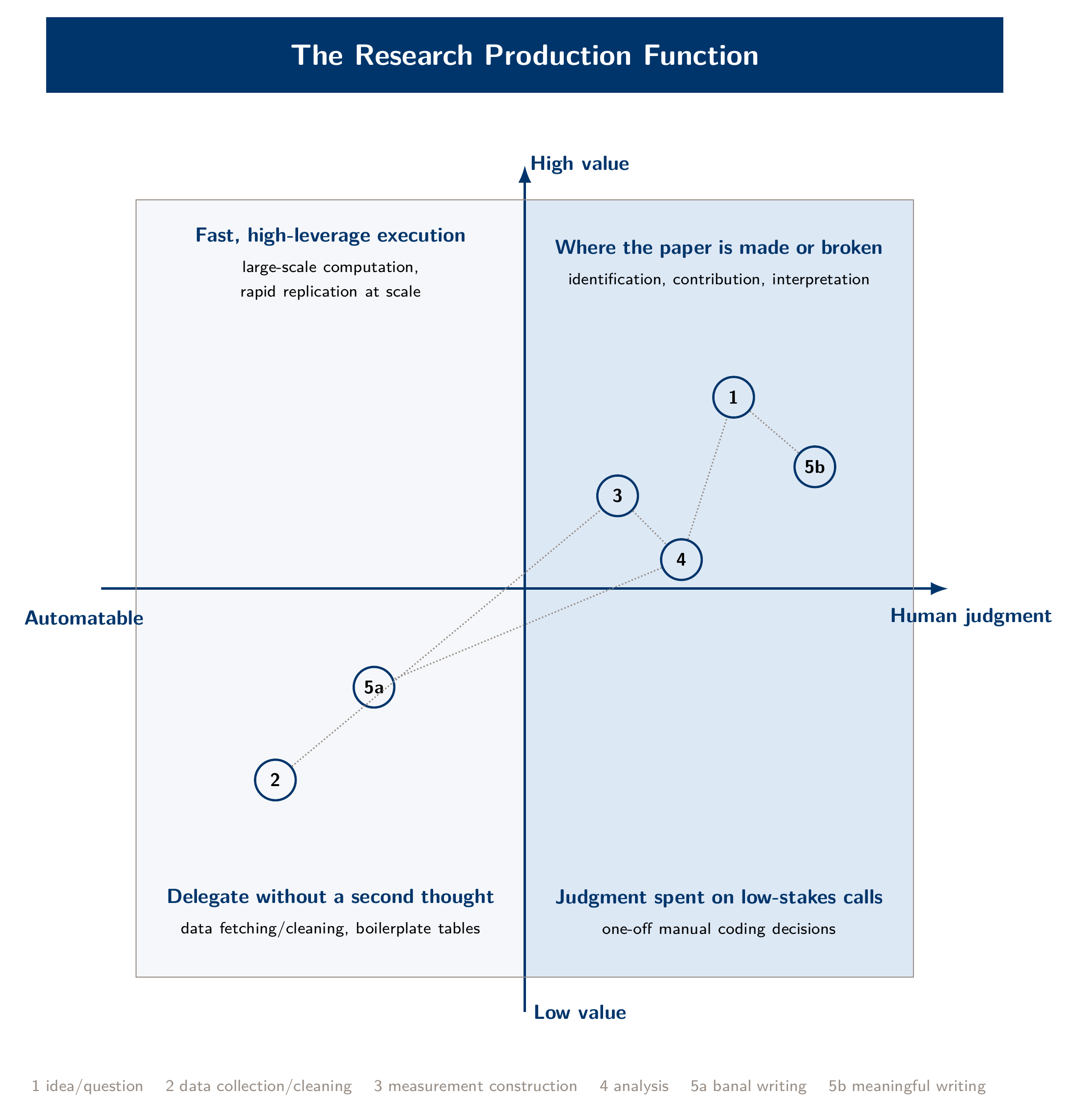
Most of this course worked in the upper-left quadrant: execution work that an agent does faster than you and about as well. The upper-right quadrant is where papers succeed or fail: identification, contribution, interpretation. The rest of this module builds on one uncomfortable observation. The boundary between those quadrants moves. Five years ago, measurement construction sat on the human side of the line. In Module 3 you moved it across in eighty minutes. At the start of the seminar, you will place your own dissertation’s stages on a blank version of this map, on your own and without discussion. Block 1 then opens with two volunteers defending their placements.
Question 1 — The artifact and the capital
A paper is an artifact: transferable, citable, and cheap to copy once it exists. A researcher’s understanding is capital. It is built only by doing the work, and it is what a PhD program exists to produce. For most of the profession’s history the two came bundled. You could not produce the artifact without building the capital, so the paper was reliable evidence about the researcher. Agentic AI unbundles them. Across this course you produced artifacts faster than your own understanding alone could have supported. The question is what happened to your capital during those same hours.
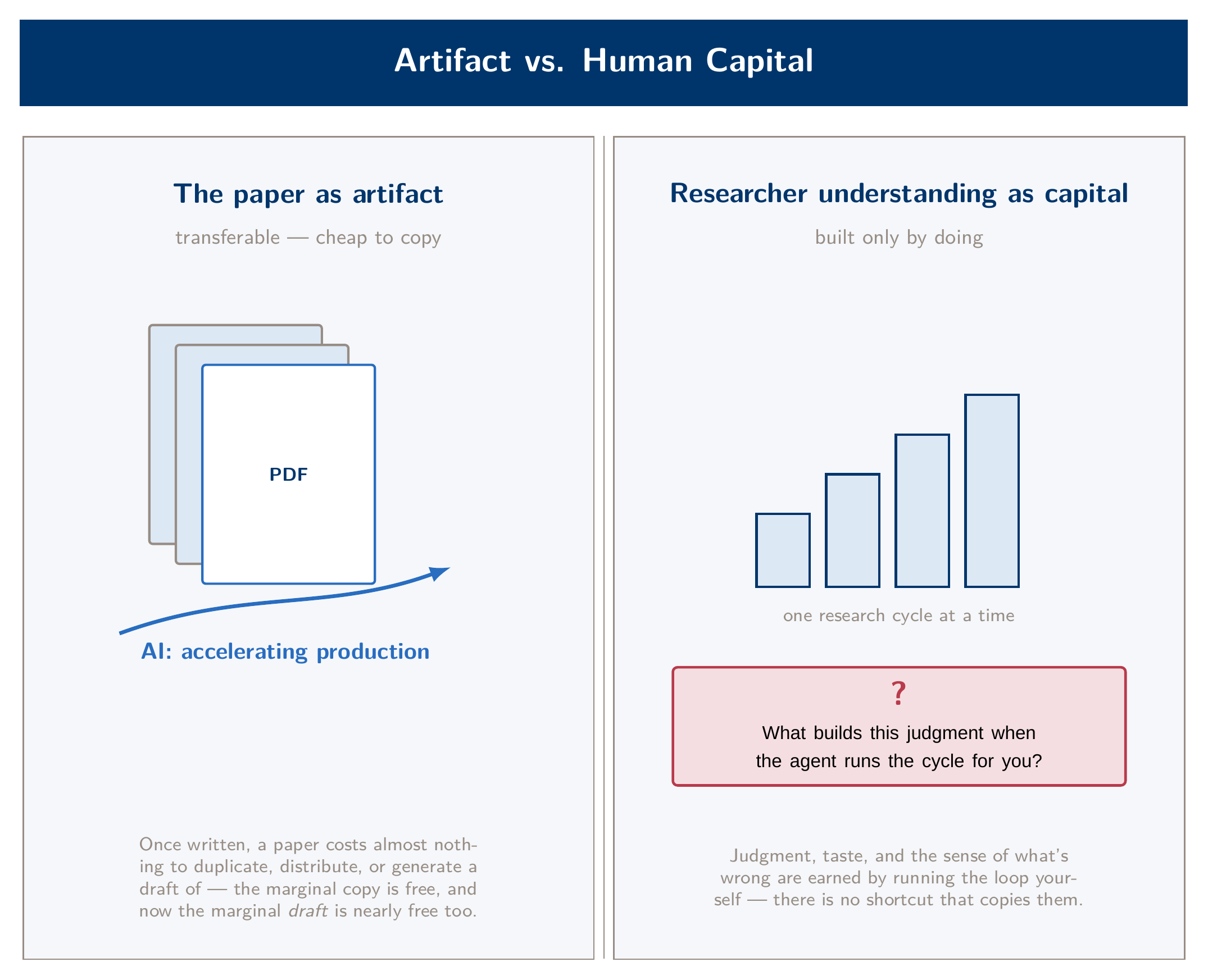
The cognitive-science evidence assigned for this module is not reassuring. Macnamara and coauthors argue that AI assistance takes over the demanding sub-tasks through which expertise gets built, and that skills decay without the performer noticing. Their analogy is autopilot in aviation: pilots did not feel their hand-flying skills eroding either. Gerlich’s survey evidence points the same way, with one finding worth debating. Higher educational attainment weakens the effect but does not eliminate it. Does graduate training give you the metacognitive habits to use these tools without losing skill, or does it only delay the decline? This room is well placed to argue that question.
Module 5 gave you the personal version of this question: the banal/meaningful line and its test, which asks whether you can discuss the finding without the LLM. This module asks the institutional version. If researchers no longer have to build the capital to produce the artifact, does the profession keep building it on purpose, the way we still teach proofs to students who will never prove anything new? Or does PhD training gradually turn into something else?
Question 2 — Provenance: man versus machine
Take two identical extraction results from the Module 3 pipeline. An RA hand-coded one over three weeks. The other came from a Claude session with a complete audit trail: cached inputs, a quality report, committed code, and a stratified human audit sample. Are they epistemically equivalent? Should a referee treat them identically? Most people’s intuitions say both no and yes, and this block works through that conflict.
The institutional reference point for this discussion is Nature’s editorial position, which has two parts. No language model will be credited as an author, because authorship carries accountability that a model cannot take on. And any use of these tools must be documented. The first part echoes a line from a 1979 IBM training manual, written four decades before the technology: a computer can never be held accountable. The second part is where the profession is now putting its practical effort: disclosure policies, audit trails, and verification as the basis of credibility. You built that discipline in Module 5. The paper trail was not mainly about catching Claude’s mistakes. It was about making your work readable to a profession that is about to care a great deal about provenance.
Two complications make this less tidy. First, a spotless audit trail can still deliver a wrong estimate. Documentation tells you where to look; it does not prove the work was done. You saw this yourself when the DECISIONS.md file claimed a robustness check that the commit history did not contain. Second, the field has supplied a case study. In 2024 a working paper claimed that a randomized rollout of an AI materials-discovery tool raised researcher output by 44%. It circulated to acclaim from some of the most prominent economists in the field before it was found to be fabricated and withdrawn, and its author was severed from MIT. The provenance-checking machinery of economics failed before AI was writing papers. Does AI make that machinery stronger (audit trails, replication at near-zero cost) or weaker (volume, plausibility at scale)? That is the sharpest version of Question 2, and it is still open.
A ten-minute segment in this block takes up a narrower epistemics question raised by Module 5’s clean-room referee. When a second model, or a fresh session of the same model, reviews the first model’s work, what is being verified? Correlated training plausibly produces correlated blind spots. The review catches real errors, and you saw it catch one, but it is not independent in the sense a statistician means.
Question 3 — The market for papers
Papers are how this profession pays people. Placement, tenure, prestige, and salary all clear through a market in which publications are the currency, and that currency has always been expensive to produce. From your own work in this course, you now have a rough sense of how far that cost has fallen.
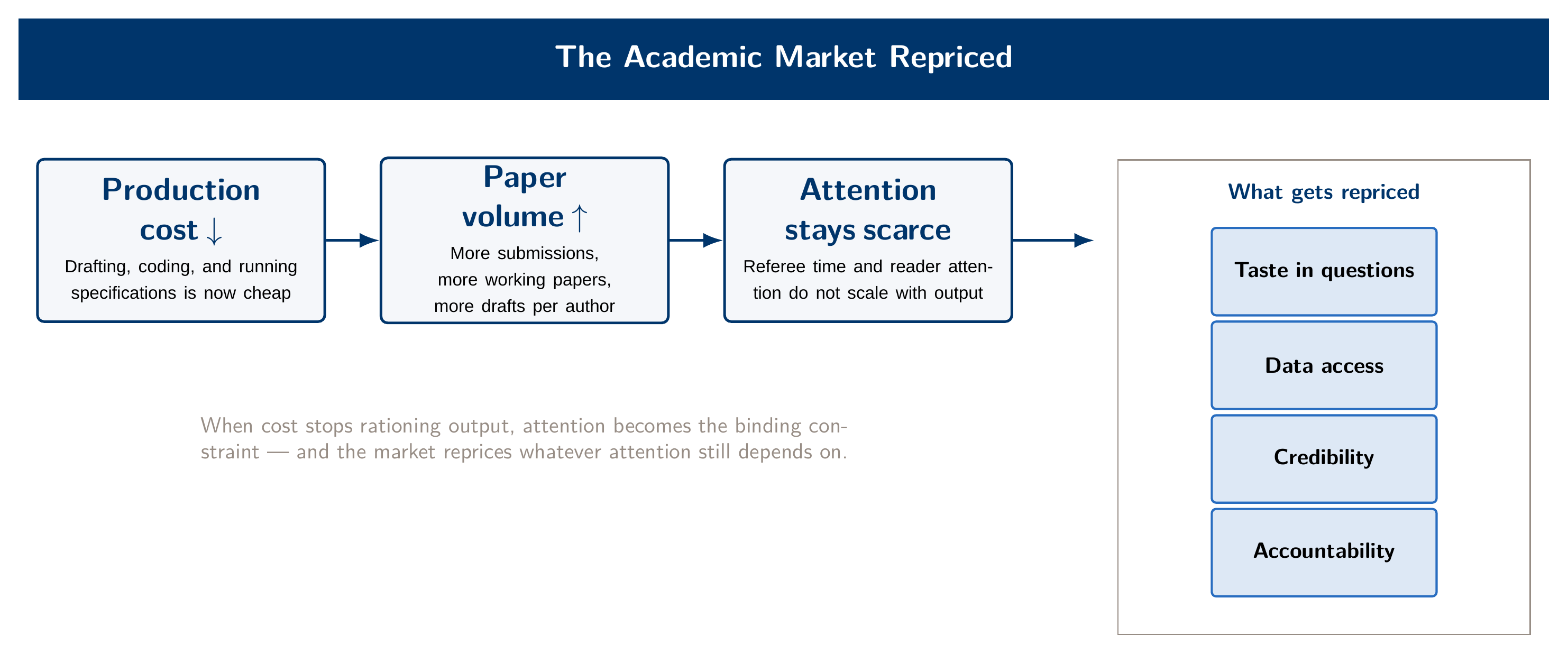
The assigned readings describe the pre-AI baseline, and it was already strained. Bloom, Jones, Van Reenen, and Webb document that ideas have been getting harder to find for decades: research productivity has fallen even as research effort has grown. Hadavand, Hamermesh, and Wilson document that economics publishes more slowly than any adjacent field, with most of the delay in authors’ own revision cycles. Lusher, Yang, and Carrell provide the congestion result that bears most directly on you. When more working papers come out in the same week, each one gets fewer downloads, less attention, and worse publication outcomes, and the effect is not confined to weak papers. Now run a thought experiment. Suppose every accounting PhD student in the world can do what you did in Module 4. What does the JAR submission queue look like in five years? Who referees it? What happens to the signal value of a publication when the floor of publishable quality rises and the volume triples?
The economics of the answer is older than the technology. When a production input gets cheap, the surplus moves to whatever remains scarce. It is worth being specific about what stays scarce in research, because those are the assets to invest in during your remaining PhD years. The first candidate is question taste: knowing which of the now-cheap papers is worth writing. The second is data access and institutional knowledge. The WRDS subscription mattered across this course, and so did knowing that consol='C' exists. The third is credibility, a reputation for careful work, which the Module 5 disciplines build over time. The fourth is accountability, which the IBM manual says a computer can never carry. A homogenization question also belongs here. If everyone’s referee reports and prose pass through the same models, voice stops being a signal. Is that a market failure, because peer review relied on the signal, or a mild efficiency gain, because house styles compressed voice anyway? That is one of the assigned debate positions, and the answer is less obvious than it looks.
Format, readings, and the memo
The seminar runs about two and a half hours. A forty-minute framing lecture covers the three questions above. Three structured discussion blocks of roughly thirty minutes each follow. Each block has position statements from the assigned debaters, open discussion, and an instructor synthesis, and each closes on a named question. The dissertation-placement exercise opens Block 1. There is no lab and nothing to install. The course’s build modules are your evidence base; cite them the way you would cite data.
Required readings (distributed Module 5; under 90 minutes total):
- Korinek, Anton (2023). “Generative AI for Economic Research: Use Cases and Implications for Economists.” Journal of Economic Literature 61(4): 1281–1317. Read pp. 1281–1290 and the speculative section, pp. 1310–1317.
- Bloom, Nicholas, Charles I. Jones, John Van Reenen, and Michael Webb (2020). “Are Ideas Getting Harder to Find?” American Economic Review 110(4): 1104–1144. Read the introduction and conclusion.
- Macnamara, Brooke N., et al. (2024). “Does Using Artificial Intelligence Assistance Accelerate Skill Decay and Hinder Skill Development Without Performers’ Awareness?” Cognitive Research: Principles and Implications 9(1): 46. Read in full (12 pages, open access).
- Editors of Nature (2023). “Tools Such as ChatGPT Threaten Transparent Science; Here Are Our Ground Rules for Their Use.” Nature 613: 612. Read in full (2 pages).
- Lusher, Lester, Wenni Yang, and Scott E. Carrell (2023). “Congestion on the Information Superhighway: Inefficiencies in Economics Working Papers.” Journal of Public Economics 225: 104978. Read in full (~8 pages).
Accounting-specific option: if the seminar leans accounting rather than economics, swap one of these in for Lusher, Yang, and Carrell. Kim, Muhn, and Nikolaev (2024), “Financial Statement Analysis with Large Language Models” (SSRN 4835311), in which GPT-4 outperforms the median analyst at predicting earnings changes. That one case study raises both Question 2 and Question 3. Or Dong, Stratopoulos, and Wang (2024), “A Scoping Review of ChatGPT Research in Accounting and Finance,” International Journal of Accounting Information Systems 55: 100715, for the current state of research in the field.
A final observation comes from the course rather than the readings. The course introduced each of its disciplines as hygiene: verify before you sign off, ask for the paper trail before the work happens, and make the pipeline rerunnable by a stranger. This module’s discussion suggests another reading. In a market where competent artifacts are cheap, demonstrated care is product differentiation. The verification protocols are not overhead on your research. Increasingly, they are part of the research itself, and they are the part a machine cannot yet sign.