Abstract
We examine the extent to which the labor market facilitates the diffusion of tax-planning knowledge across firms. Using a novel data set of tax-department employee movements between S&P 1500 firms, we find that a firm increases its tax planning after hiring a tax-department employee away from a tax-aggressive firm. The result is robust across research designs and specifications.
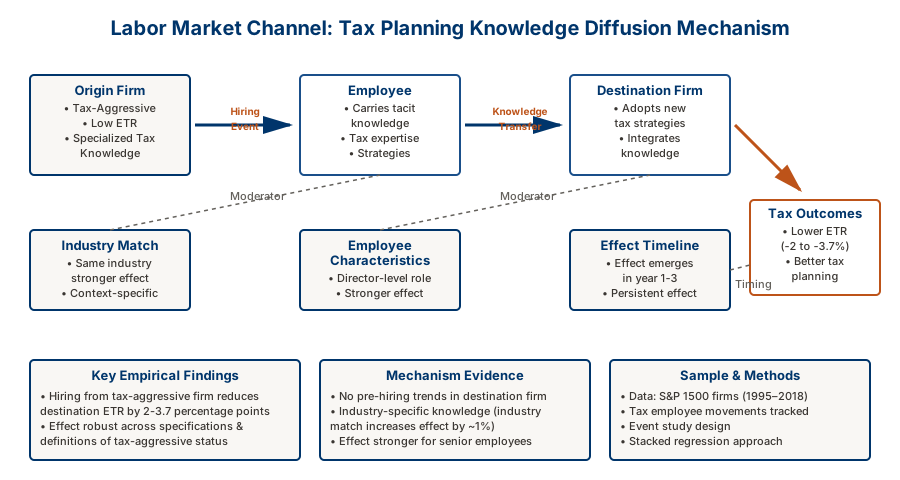
Consistent with tax-planning knowledge driving the effect, the benefits are larger when the hired employee held a director-level role and had more experience, and when the hiring and former firms are similar—operating in the same sector or having comparable foreign operations. We do not find that the prior firm's tax planning changes after the employee departs, suggesting the knowledge spreads to the hiring firm without leaving the origin firm. Tax-department human capital emerges as a central determinant of firms' tax-planning outcomes.
Key Findings
Knowledge Moves with Workers
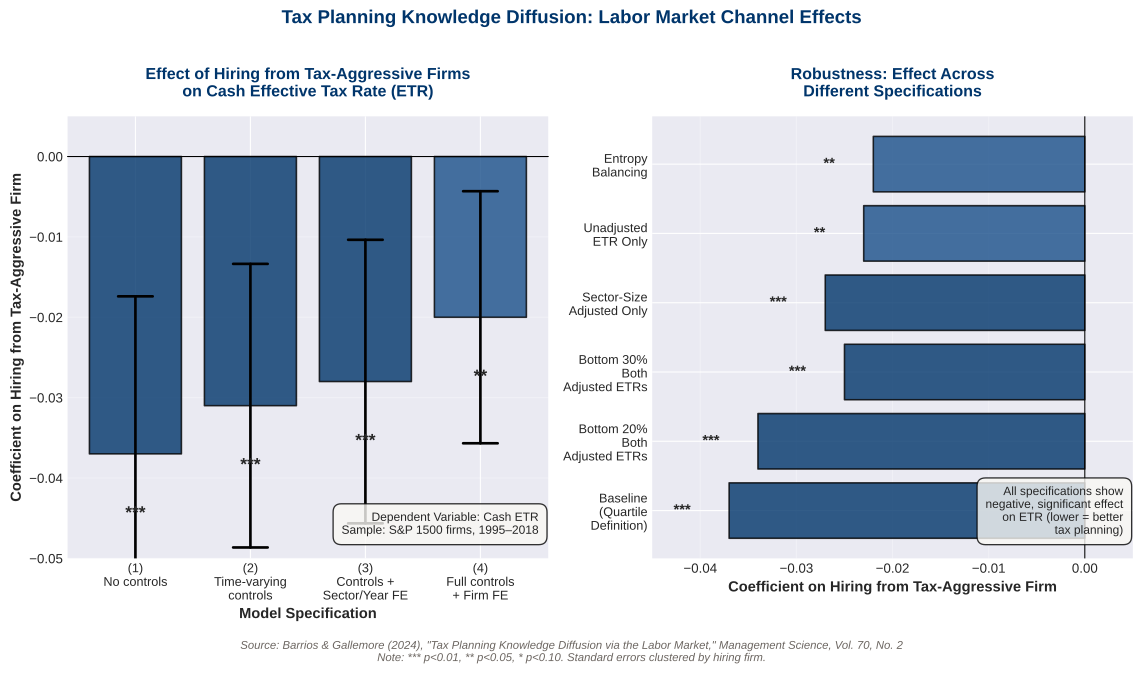
Hiring a tax-department employee away from a tax-aggressive firm lowers the destination firm's cash effective tax rate by about two percentage points (7% of the sample mean), rising to 2.7 points in the movements-only sample—direct evidence that tax-planning expertise diffuses through the labor market.
Sector-Specific Expertise
The increase in tax avoidance is larger when the hiring and former firms are similar (same sector or comparable foreign operations), and firms tend to hire from firms like themselves—so the knowledge is highly context-specific.
Experience Matters
Benefits are more substantial when the hired employee held a director-level role and had more experience, consistent with tax-planning know-how that is tacit and hard to codify.
No Depletion at the Origin Firm
The former firm's tax planning does not change after the employee leaves—knowledge spreads to the hiring firm without being lost at its source.
Figures
Data and Research Design
We build a novel data set of tax-department employee movements between S&P 1500 firms, identifying 1,083 moves from 1998 to 2015 by crossing firms that hire a tax-department employee from another firm in a given year with the employees hired into their tax departments. A prior firm is classified as tax-aggressive when both its economy-wide adjusted and its sector-size adjusted five-year cash ETRs fall in the bottom quartile of the movements sample.
Our tests use difference-in-differences and stacked event-by-event designs that compare a hiring firm's tax planning before and after it brings on an employee from a tax-aggressive firm, drawing on the S&P 1500 firm-year panel (1995–2018) and clustering standard errors by firm. The effect holds across these designs and is not driven by differential pre-hiring trends.
Research Contribution
This paper documents a first-order role for the labor market in the diffusion of tax-planning knowledge across firms. While prior work studies how tax practices spread through auditors, advisers, and board interlocks, we show that the movement of tax-department employees themselves is a central channel—one through which firms acquire specialized, largely tacit expertise that is difficult to codify or buy off the shelf.
The findings position tax-department human capital as a key determinant of firms' tax-planning outcomes. Because the knowledge is sector-specific and travels with individual employees, the mobility of tax professionals shapes where tax-planning capacity accumulates, with implications for how advantages in tax planning are built and sustained.