Abstract
We examine how research changes when a journal requires authors to document their data and provide the code used to build their samples. The Journal of Accounting Research (JAR) introduced this requirement for all empirical submissions in January 2015, while its closest rivals did not. We study roughly 4,600 articles from six journals around the policy change.
Consistent with disclosure limiting authors’ discretion, JAR papers published after the mandate are easier to read, rely less on hedging language, and report results more comprehensively. The reduction in hedging is largest for studies with the weakest headline results. Consistent with the policy changing who submits, JAR moves toward more novel work from scholars at top research universities; its articles receive fewer citations overall, but from more prominent outlets. The writing effects are absent from exempt theory articles and reappear when another journal adopts a comparable requirement. In sum, increasing the openness of the research process influences not only what can be checked and reproduced, but also what gets written and who ultimately publishes in which outlets.
Key Findings
Behavioral margin: how a given author writes
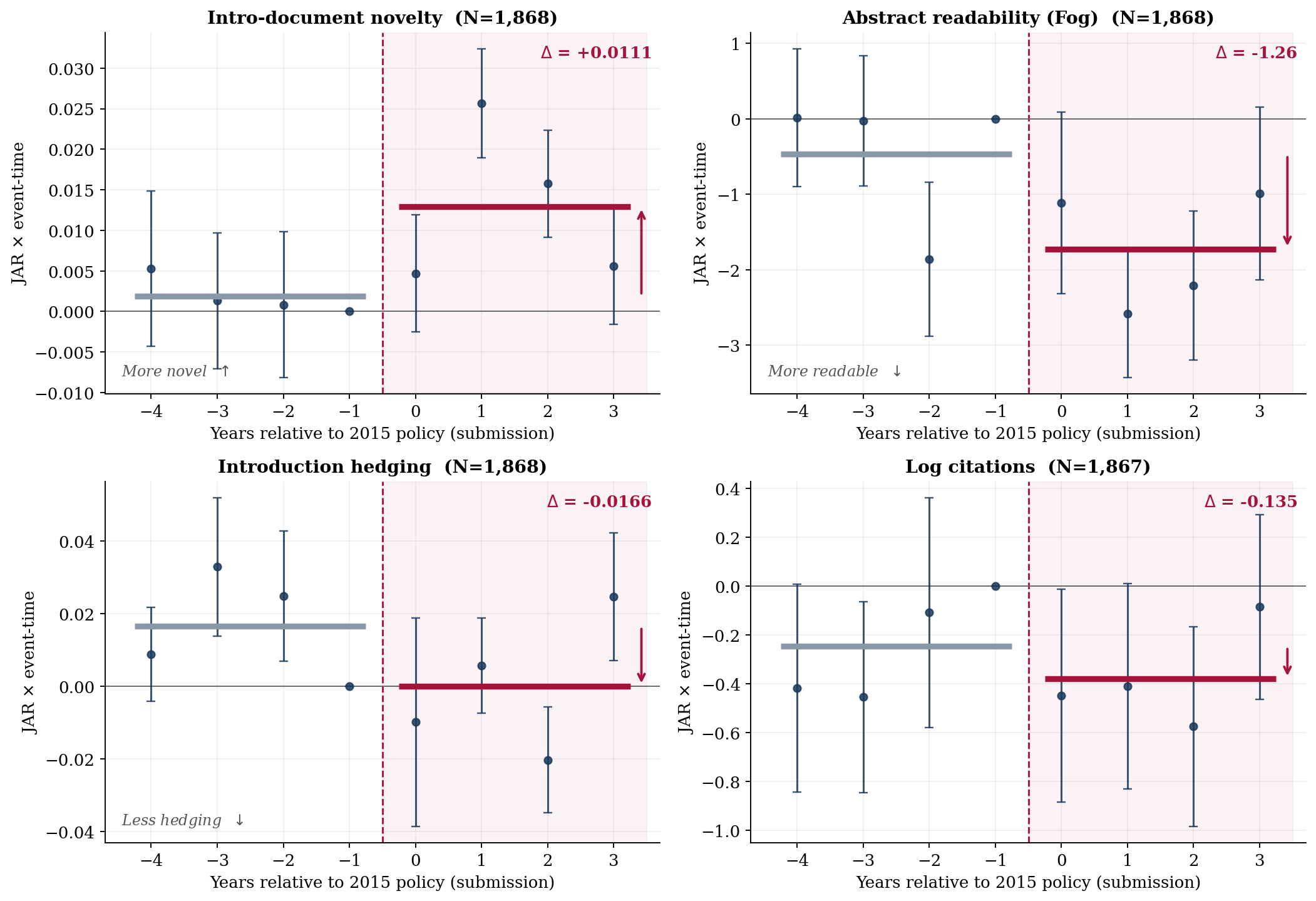
Post-mandate JAR abstracts fall by about 1.3 Fog points (Δ ≈ −1.26)—more readable prose—and introduction hedging declines (Δ ≈ −0.027 to −0.028). Put differently, authors write more plainly and stake fewer qualified claims where they frame and interpret results. The same papers also report fewer headline results and surround each claim with more supporting coefficients. We do not, however, find much evidence that reported test statistics pull away from the just-significant region.
Market margin: who submits and what gets placed
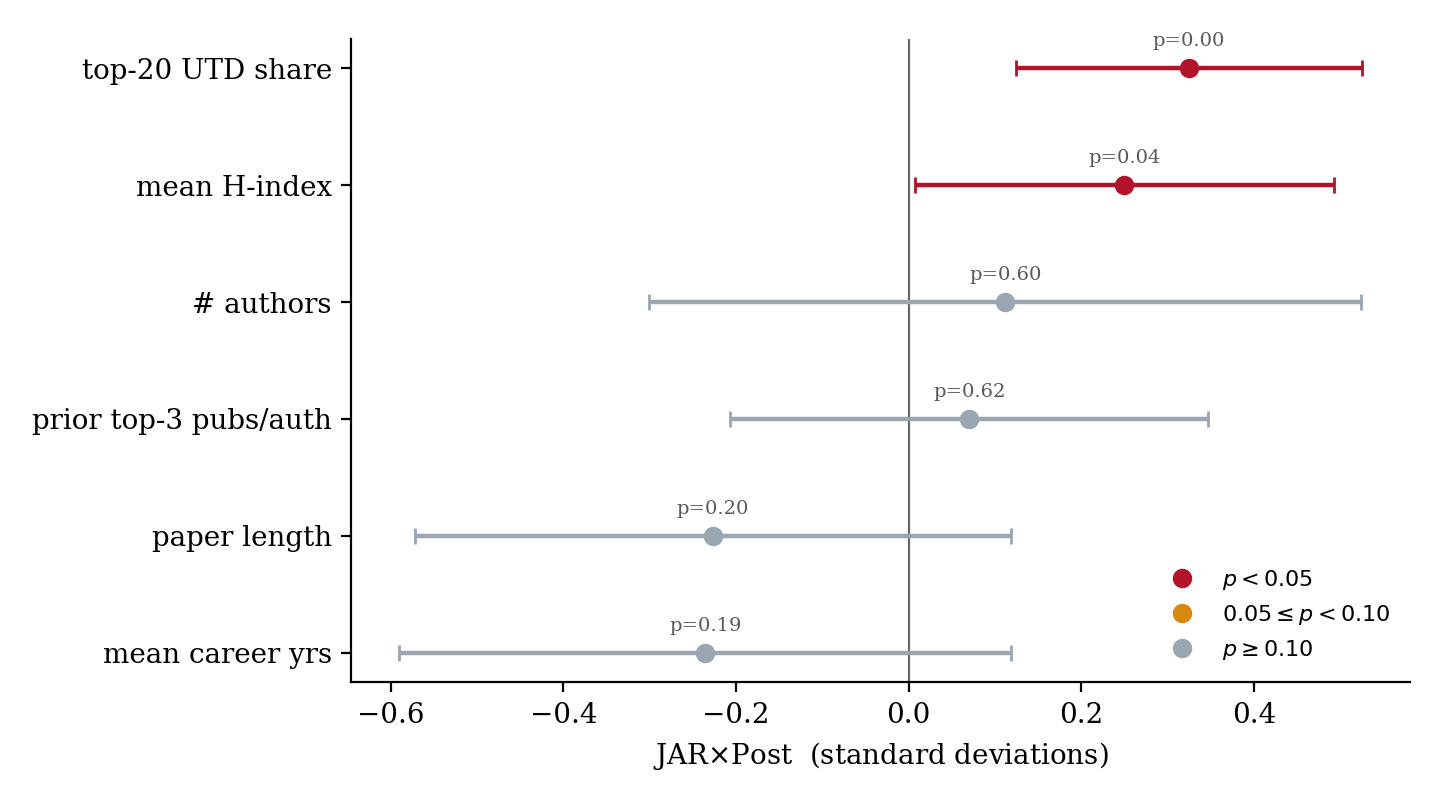
Measured novelty rises at the journal level (intro-document novelty Δ ≈ +0.013 to +0.014). Once we hold author identity fixed, the novelty change is essentially zero—consistent with selection rather than a given author writing more original papers. Along the same margin, post-mandate JAR authors are about 0.3 SD more likely to be at a top-20 UTD department and carry a higher mean h-index (≈0.25 SD).
Citation composition, not just citation counts
Log citations fall after the mandate (Δ ≈ −0.28 to −0.29)—roughly a quarter fewer. The citations that remain come from more prominent outlets—including a larger share from premier business journals outside accounting. Put differently, the audience shrinks while the marginal reader is drawn from higher-status venues.
Placebos that separate behavior from composition
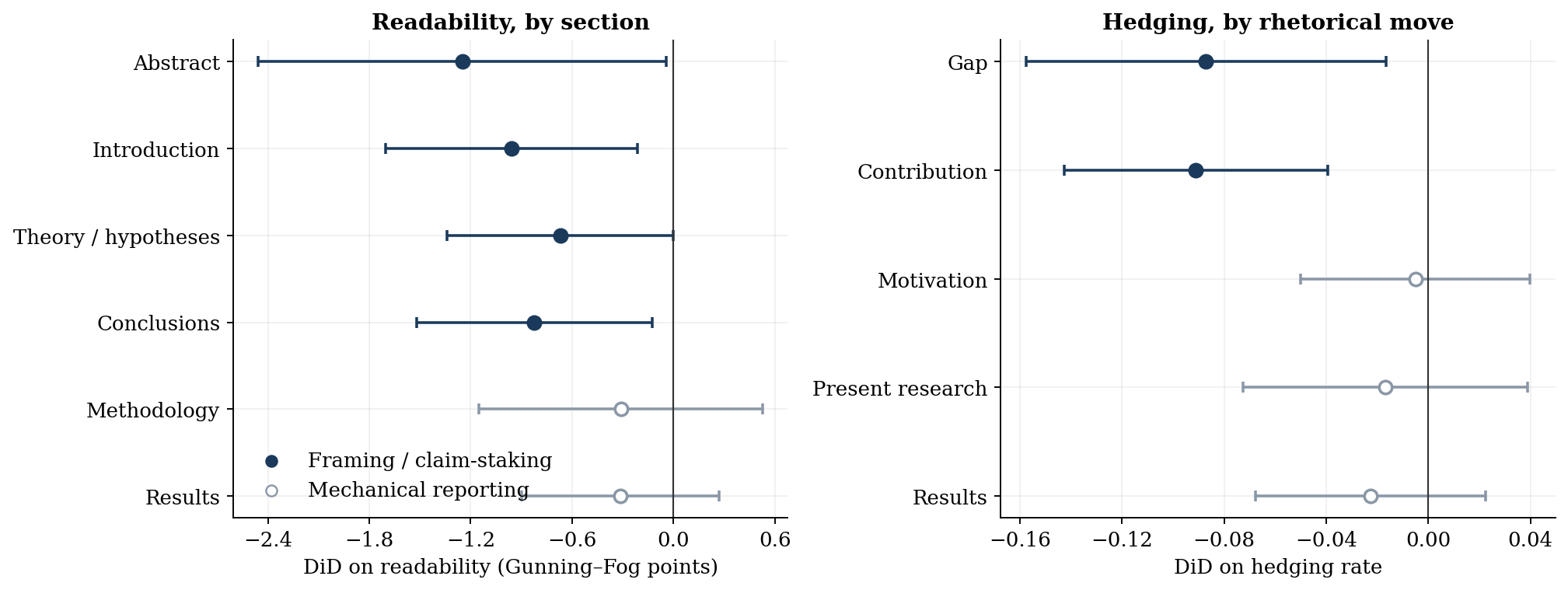
Writing effects concentrate in framing sections (abstract, introduction, contribution moves) and are weak in mechanical methods and results sections. They are absent for theory papers exempt from the mandate, and they reappear when Management Science adopts a comparable data-and-code rule—patterns a pure compositional story would not anticipate.
Figures
Research Contribution
Most of what we know about transparency mandates concerns whether published results can be replicated. Far less is understood about how the anticipation of disclosure changes the research that gets written and the population of researchers who write it. In this paper, we exploit JAR’s 2015 data- and code-sharing policy—adopted unilaterally, on a clean date, while peer accounting journals did not follow—to examine that supply-side question.
Our study offers several contributions. First and foremost, we show that a self-certified disclosure rule without an in-house data editor still moves both a behavioral margin—how a given author writes and reports—and a market margin—which authors and projects arrive. Second, we provide a portable template for separating those margins when a single outlet changes disclosure rules: author fixed effects, a second treated journal, within-field theory placebos, and never-treated field benchmarks. Third, we treat the research paper as a disclosure document and measure prose, novelty, reported inference, and citation composition with text-as-data tools. Overall, these results suggest that opening the research pipeline reshapes the market for ideas, not only post-publication auditability.