Abstract
We study the role of civic capital in facilitating collective action during the early stages of the COVID-19 pandemic. Using real-time cellphone location data and variation in social distancing recommendations across U.S. counties, we examine whether areas with higher civic capital exhibited greater compliance with social distancing guidelines when formal enforcement was limited.
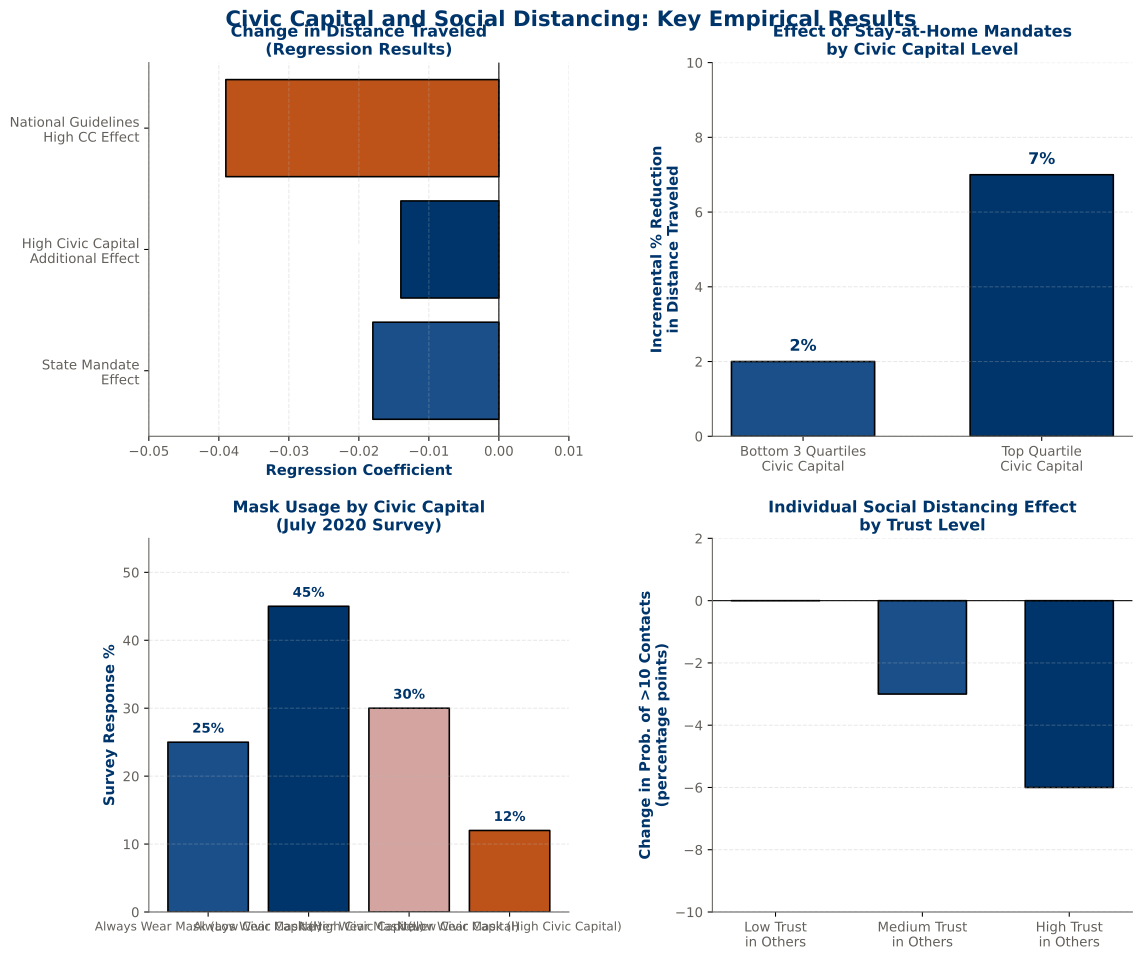
We find that counties with higher civic capital—measured primarily by voter participation, with a broader county social-capital index used for robustness—experienced significantly larger reductions in mobility and greater social distancing compliance following public health recommendations. Under stay-at-home mandates, high–civic-capital counties cut mobility by an incremental 7 percent, versus 2 percent in the bottom three quartiles. These effects are largest in the early weeks of the pandemic, before the widespread adoption of formal restrictions, suggesting that civic capital enables communities to coordinate on socially beneficial behaviors even without enforcement.
Key Findings
Civic Capital Drives Compliance
Under stay-at-home mandates, high–civic-capital counties reduced mobility by an incremental 7 percent (versus 2 percent in the bottom three quartiles), with stronger adherence even before mandatory restrictions.
Early Response Advantage
The civic capital effect was strongest in the critical early weeks of the pandemic, when voluntary compliance was most important for slowing disease spread.
Protective Behaviors
Residents of higher–civic-capital counties were more likely to wear masks (Exhibit 3) and to report fewer risky social contacts (Exhibit 4), consistent with the voluntary adoption of protective behaviors.
Compliance Beyond Mandates
High–civic-capital counties kept distancing even after states reopened, when the law no longer required it—evidence that civic capital sustains voluntary collective action.
Figures
Research Contribution
This paper makes several contributions to our understanding of civic capital and collective action. First, we provide large-scale empirical evidence that civic capital facilitates coordination on socially beneficial behaviors during crises. While prior research has documented correlations between civic capital and various social outcomes, the pandemic provides a unique natural experiment where the returns to collective action were clear and immediate.
Second, we demonstrate that civic capital can act as a substitute for formal enforcement and government capacity. This has important implications for understanding how communities respond to crises and for evaluating policies that rely on voluntary compliance. The results suggest that investments in civic capital may have important option value during emergencies when formal institutions are overwhelmed or slow to respond.
Third, we contribute to the growing literature on the political economy of the COVID-19 pandemic. Our findings show that beyond partisan politics and policy choices, underlying social capital shapes how communities respond to public health threats. This heterogeneity in collective action capacity has important implications for pandemic preparedness and response strategies.
Measurement and Identification
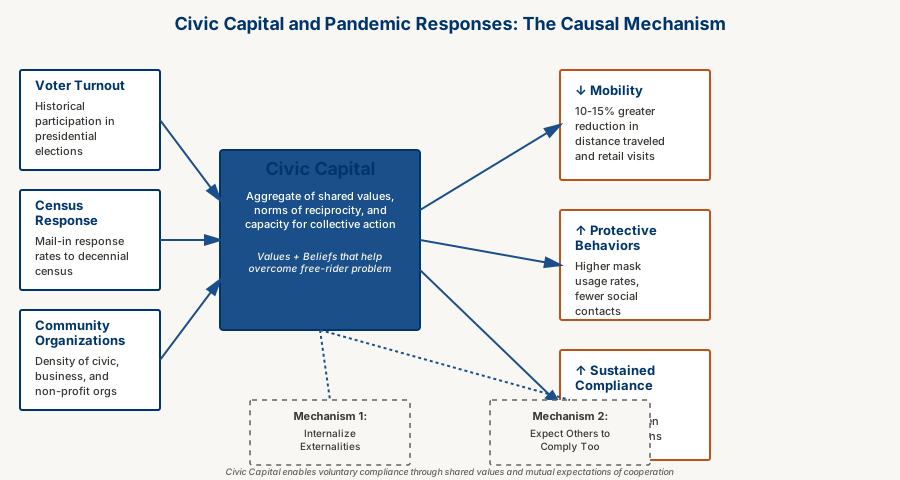
Our primary measure of civic capital is average voter participation across the 2004–2016 presidential elections. For robustness we also use the Rupasingha et al. (2006) county social-capital index, which incorporates census response rates and the density of civic and social organizations. These measures capture complementary dimensions of civic engagement and cooperative behavior.
Our identification strategy exploits the timing of public health recommendations and the availability of real-time mobility data from cellphone pings. We use a difference-in-differences approach comparing mobility changes in high versus low civic capital counties before and after social distancing recommendations, controlling for a rich set of demographic, economic, and political characteristics.
Policy Implications
Our findings highlight the importance of social capital for crisis response and pandemic preparedness. Policies that strengthen civic institutions and community engagement may have important positive externalities during emergencies by facilitating voluntary compliance with public health measures.
The results also suggest that public health communication strategies should be tailored to account for variation in civic capital across communities. In areas with lower civic capital, more intensive enforcement or stronger incentives may be necessary to achieve similar levels of compliance. Understanding this heterogeneity can improve the effectiveness and equity of pandemic response policies.