Accounting research pipeline: skills, MCP, and verification
Skills teach how — Compustat filters, CIK discipline, attrition rows. MCP servers run live access — authenticated WRDS queries, EDGAR filings, macro series, with credentials in .env and never in chat. Neither replaces verification: agents make pipelines cheap to produce, and the costly part stays yours.
The nine stages of an archival accounting paper, from empty folder to seminar-ready draft. Click a stage node to jump to its card.
The small set for a first Compustat firm–year paper, with optional EDGAR text and a Stata or Python estimator. Everything else in the catalog (Bayesian, geospatial, posters) can wait. Browse the full catalog when you need it.
Skills to install first
Role
Skills
Data access conventions
wrds; add sec-edgar if any filing work
Panel & estimate
Stata lane: stata-data-cleaning + stata-regression; Python lane: pyfixest + python-panel-data
Output
latex-tables, econ-visualization
Write & check
econ-write, econ-humanizer, econ-referee; parse the PDF first with paper-pdf
Either / both: MCP to discover; skill for pinned reproducible scripts
Stata clean / reghdfe / esttab
stata-data-cleaning, stata-regression
Stata-MCP
Both if the agent drives Stata; skill only if you run .do files yourself
Panel FE in Python
pyfixest, python-panel-data
none
Skill only
Lit search / BibTeX
citation-management
none
Skill only
Figures / LaTeX tables
econ-visualization, latex-tables
none
Skill only
Paper / slides / referee prep
paper-pdf, econ-write, econ-slides, econ-referee
none
Skill only
Choosing the tool rung
—
—
Chat for thinking; editor for edits; agent for pipelines; agent + MCP only when live licensed or public APIs are required
The nine stages
Each stage lists its default skills, the MCP server if one applies, and the verification gate you pass before moving on. Chip text opens the skill in the catalog; the arrow downloads the zip.
1
Research question and literature
Question
Sharpen a question that Compustat, CRSP, EDGAR, or a public panel can answer; map prior designs and measurement conventions before writing any code.
Name the identifying variation and the unit of observation (firm–year, filing, event) in one sentence. If you cannot, do not open a data session yet.
2
Empty folder and the six-part opening prompt
Question
Start in a clean directory and write the six-part prompt before any code runs. Require named scripts, DECISIONS.md, LOG.md, and attrition rows, not chat-only results.
MCPNone at prompt-writing time; MCP comes online in stage 3. Install wrds / sec-edgar here so the prompt carries the iron laws and CIK discipline from the start.
Verify this
Paste the six headings. Fill in every blank an agent would have to guess: years, tags, filters, join key, filename.
3
Live data pull
Data
Pull WRDS extracts, EDGAR filings and XBRL facts, and macro controls into data/raw/. Every pull, authenticated or bulk, ends as files on disk.
Credentials live in .env, never in chat. The MCP server reads WRDS_USERNAME and related variables from an env file with chmod 600. If a password ever appears in a prompt or a log, rotate it.
Verify this
Four inspections before trusting any extract: (1) row count vs an expectation written down beforehand, (2) a sample of rows, (3) null check on the analysis columns, (4) date-range min/max. Compustat SQL must include indfmt='INDL', datafmt='STD', popsrc='D', consol='C'. CRSP share-type and exchange filters are manual. Never assume a helper applied them.
4
Clean, join, attrition panel
Data
Turn raw extracts into an analysis-ready firm–year panel. Join on the correct key: gvkey–fyear, adsh, the CCM link table. Never join on hand-typed tickers. Print attrition at every filter.
MCPNone. Scripts on disk. Stata-MCP is optional if cleaning runs in Stata interactively (see the MCP install guide).
Verify this
One join check: n before, n after, and the reason for every drop. Flag unmatched keys. No silent row inflation from many-to-many joins.
5
Disclosure and EDGAR text measures (optional branch)
Text
CIK resolution → filing retrieval (cached HTML) → section extraction with fallback patterns → quality report → text feature or NLP score. Construct validity is the accounting contribution; automation is not the finding. Resolve and pin CIKs: ticker strings are not stable firm ids across EDGAR joins.
Read the quality report: the failures and the suspiciously short sections, not the headline success rate. Before a text measure enters a main table, run a stratified human audit (~50 filings across measure level, size, and industry) against a written rubric.
6
Construct measures and sanity EDA
Data · Estimate
Build ratios, treatments, instruments, and controls; winsorize or trim with documented rules; plot distributions and known-event windows before any regression.
Name two checks before looking at the figure: (1) benchmark industries or firms where you hold a strong prior, (2) plausibility around a known shock. Write both into the README.
7
Estimation and identification
Estimate
Run the main specs and pre-committed robustness: FE OLS, Poisson, IV, DiD including modern estimators, clustering. Prefer high-dimensional FE tools that match accounting panel practice: pyfixest if Python, stata-regression if Stata.
MCPStata-MCP if the agent drives Stata (see the MCP install guide); otherwise none.
Verify this
Check one coefficient or N from the log file against an independent re-run or a hand calculation on a tiny subsample. Confirm FE and cluster choices match DECISIONS.md.
8
Tables, figures, and the paper trail
Write
Export publication tables and figures from scripts. Every manuscript number comes from a generated file, \input{} or a read CSV, never hand-typed from a terminal. Finish the README so a stranger can rerun the project from empty folder to figure.
Pick one table cell. Check it against the script output file and confirm the manuscript inputs that file. No copied digits.
9
Manuscript, slides, pre-submission verification
Write
Draft and revise, strip AI tells, build the seminar deck, and run an adversarial pre-submission pass. The default writing sequence: econ-write → econ-writing-plus for identification prose → econ-humanizer (plus econ-humanizer-plus) for voice.
Cross-check one DECISIONS.md claim against the git commit it cites. Run a credential audit: grep the history for secrets; it should come back empty. On identification, the agent is an editor, not a rewriter: comments only, no ghostwritten argument.
Verification debt
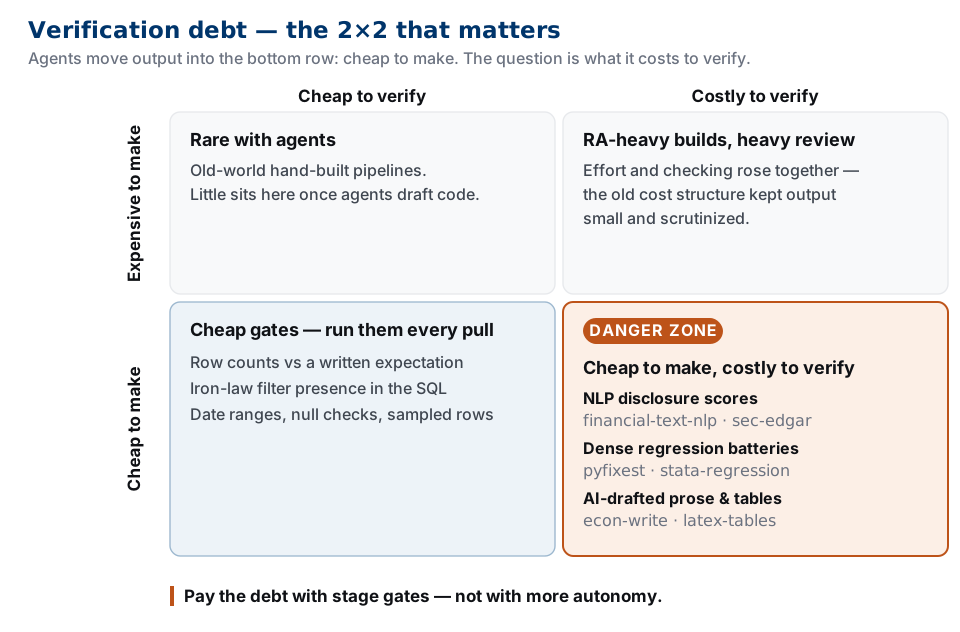
Agents break the old correlation between effort and checking: output that once took a week of RA time now appears in minutes, and the checking cost did not fall with it. The danger sits exactly where this catalog is strongest: text measures from financial-text-nlp plus EDGAR, dense pyfixest / stata-regression batteries, and fluent econ-write drafts. All of it is cheap to produce and expensive to validate.
Cheap to make, costly to verify: where agent output accumulates debt.
Pay the debt with the stage gates above, not with more autonomy. Row counts, iron-law filter checks, and date ranges are cheap; run them every time. Human audits of text measures and independent re-runs of headline coefficients are expensive; budget for them before the result enters a main table.